Latest news articles
- SAS Executive Board Reading Recommendations – “Viscous remanent magnetization authentication method for archaeological artifacts”
- Announcement: new SAS officer email addresses
- “Burning the Sea” – Report from SGS Beta-SAS Radiocarbon Dating Award 2026 winner Simone Dilaria
- SAS Member Spotlight – Jayde Hirniak
- Guide to Heritage Science at SciX 2026
Conferences & Networking
The SAS regularly sponsors conferences, workshops, and conference sessions. If you are planning an event relevant to the goals of the society, please get in touch with the VP of Intersociety Relations so that we can explore a partnership. If you're a student SAS member interested in promoting professional fellowship among your peers, check out the Student Ambassador program and reach out to our VP for Membership Development to learn more.
- Braden Cordivari
October’s Executive Board Reading Recommendation comes from VP for Website Administration AJ White. AJ has picked an article on an exciting new magnetic dating technique, and he writes:
I recommend the paper, “Viscous remanent magnetization authentication method for archaeological artifacts,” by Yoav Vaknin and colleagues, for introducing a novel way to discern ancient from modern ceramics. The technique works by determining the strength of a ceramic object’s Viscous Remanent Magnetization (VRM) – more ancient artifacts require a higher VRM removal temperature (VRT) than more recent artifacts, thus providing an estimate of the age of the material. From their study, the authors find that VRT values over 112 °C suggest an age of at least one thousand years. They apply this technique to distinguishing legitimate and fake artifacts in museum collections, which is a useful application in its own right, but I wonder if in time we may be able to determine more precise ages from VRT values to directly date ceramic assemblages. Regardless, it’s not every day that you learn of a new dating method and I commend the authors for their contribution to archaeological and heritage sciences!
Vaknin, Y., Cych, B., Gee, J.S., Tauxe, L., 2026. Viscous remanent magnetization authentication method for archaeological artifacts. Proceedings of the National Academy of Sciences 123, e2620397123. https://doi.org/10.1073/pnas.2620397123
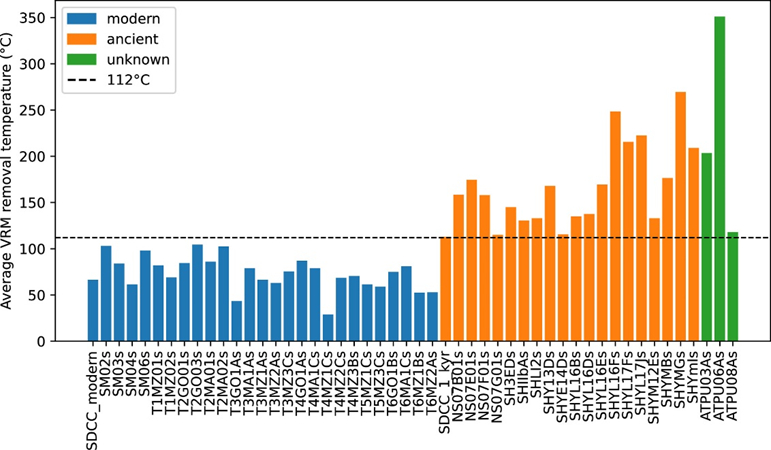
Fig 4. VRM Removal Temperature (VRT) results of all 48 actual specimens and two simulated specimens. The results are based on the VRTC python code (the average of the VRTD and the VRTM). The dashed black line marks the C threshold, which is the VRTD of the 1,000-year-old simulated specimen.
- Braden Cordivari
In order to further professionalize the operations and communications of the society and to mitigate against phishing attempts, SAS has begun using Google Workspace for Non-Profits, which enables @socarchsci.org email domains for our officers. Emails from an individual SAS Executive Officer to a member or group of members will only be sent using the email address associated with that officer's profile on this page: SAS Executive Officers. Any variation on the address shown in the profile is not valid. Previously, SAS officers listed their professional or personal email addresses on these profile pages. Beginning in October 2026, all SAS officers will only communicate with the membership or general public about SAS business using email addresses with the domain @socarchsci.org.
Official communications to all SAS members will be sent by the General Secretary using the email address
- Braden Cordivari
The SGS Beta-SAS Radiocarbon Dating Award supports the creative use of radiocarbon dating. The 2026 winner, Simone Dilaria (Department of Cultural Heritage, University of Padua), used the award for his project "Burning the Sea: 14C dating for Early Coral and Shell Calcination in Sardinia.”
Simone reports on the results of the analysis below:
This project investigates an exceptional stratigraphic context discovered in the suburban periphery of the ancient city of Nora, Sardinia. Excavations revealed a pit for lime slaking cut directly into a natural alluvial clay deposit overlying the bedrock. Crucially, this lime pit is stratigraphically cut by a Phoenician cist tomb dated to the mid-seventh century BCE based on its burial assemblage, establishing a definitive terminus ante quem for the lime-production activities. Archaeometric examination revealed that the lime was produced through the calcination of mollusk shells alongside an unusually high concentration of coral fragments. While shell calcination is attested in later Classical periods, the intentional calcination of coral is entirely unprecedented in the Mediterranean archaeological record. To establish an absolute chronological framework for this milestone in ancient pyrotechnology, the SGS Beta-SAS Radiocarbon Dating Award supported the AMS radiocarbon dating of an uncalcined coral residue, designated sample CORAL_3, embedded within the lime paste.
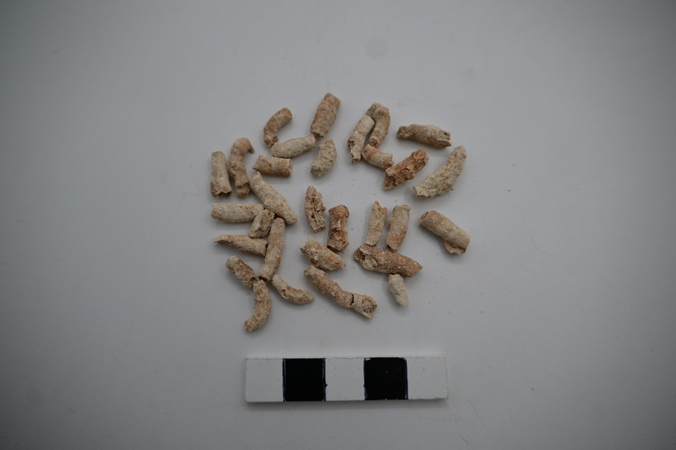
Assemblage of unburnt coral residues
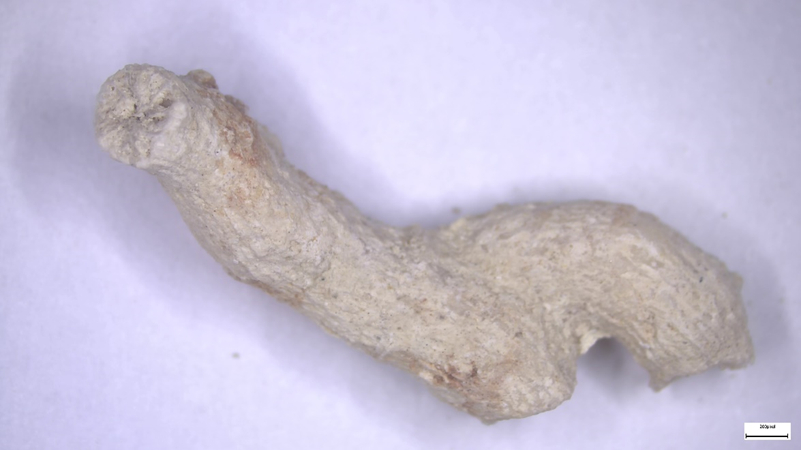
Analyzed sample of coral
The radiocarbon analysis conducted by Beta Analytic on a coral sample (CORAL_3 / Beta-818657) yielded a very surprising result: a conventional radiocarbon age of 41,690 ± 650 BP, which calibrates to approximately 44,000 cal BP (Upper Paleolithic). While this date does not directly reflect the protohistoric operational phase of the lime-slaking pit, which is stratigraphically sealed by a mid-7th century BCE Phoenician tomb, the result is analytical robust and opens up a remarkably intriguing scientific scenario. Rather than harvesting living coral from active reefs, the ancient lime-burners were apparently collecting dead, subfossil coral fragments from beach deposits or the seabed (perhaps retrieved during fishing activities) to use as raw material for lime production. This unexpected outcome provides novel insights into ancient raw-material selection and pyrotechnological practices.
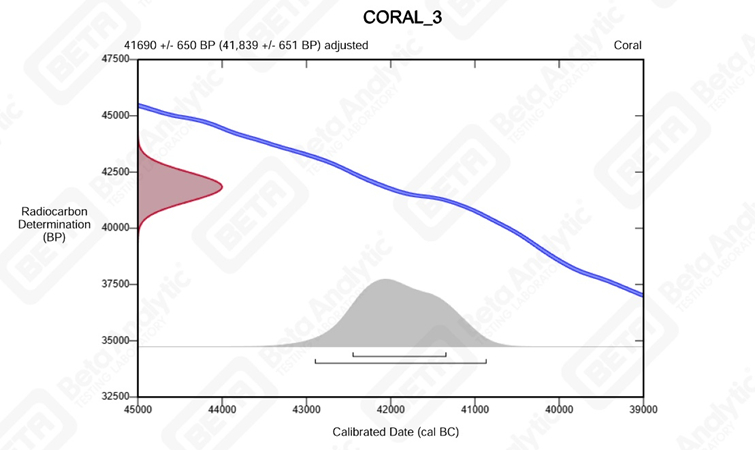
Result of the C14 dating
To further clarify the deposit's chronological framework and confirm this sourcing strategy, Simone and his colleagues plan to proceed with radiocarbon dating on the remaining samples from the context, including the Murex shell and additional coral fragments.
The results of the project and of the 14C dating will be presented in the poster "Turning the Sea to Lime: Coral and Mollusk Shell Calcination in Phoenician Nora (Sardinia)" at the XI International Congress of Phoenician Studies (Valletta in Malta, 9-13 November 2026).
Congratulations again to Simone, and our warmest thanks to SGS Beta for supporting this innovative and interesting research!
- Braden Cordivari
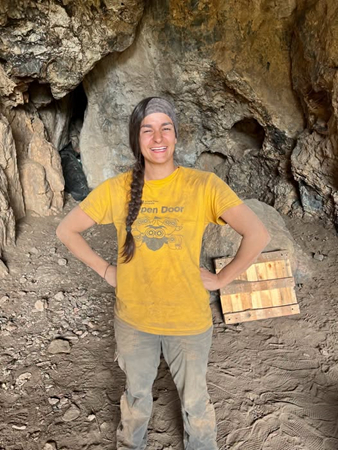
Our latest Member Spotlight is on Jayde Hirniak, Postdoctoral Research Scholar at the Institute of Human Origins at Arizona State University, and 2024 winner of the SAS Student and ECR Research Support Award.
Jayde investigates modern human origins through the impact of catastrophic events on human societies through geochemical and geoarchaeological methods including tephrochronology and cryptotephra analysis, silcrete sourcing, site formation processes. Jayde’s dissertation research used tephrochronology to link archaeological and environmental records throughout South Africa and assess the impact of volcanic eruptions on past populations by investigating for the first time in this region the geochemical make up of volcanic material, while her further postdoctoral research expands on this work through offering novel methodological advancements.
Jayde is passionate about working in the field and teaching and considers mentoring young students as very important but also fun. In her own words “when I am in the field, I don’t feel like I am working and it is when I am most creative.” Jayde finds there is something special about visiting the sites one often reads about and get to be a part of the data collection process. If Jayde had a time travel machine she would go back to the Western Cape of South Africa to observe how people lived and see if we are interpreting the archaeological record correctly. Of course, with the caveat of being able to come back! When not in the lab, Jayde enjoys the mountains, typically on a bike.
Get in touch! SAS members can always highlight their research through our Spotlight program: www.socarchsci.org/communications/sas-spotlights
- Braden Cordivari

- Braden Cordivari
Happy fall! September’s Executive Board Reading Recommendation comes from SAS VP for Social Media Vana Orfanou. Vana has selected a recently-published paper in Journal of Archaeological Science by J. Montes Landa and colleagues, titled “Towards a new history of bronze making: Explaining the selection of tin bronze alloying techniques across prehistoric N.E. Iberia (2100-200BC).”
Vana writes: This paper presents comprehensive analytical evidence to address one of the standing challenges in archaeometallurgy: How and when can we pinpoint technological choices linked to specific metallurgical operations such as natural alloying, co-smelting, mixing and recycling of copper-based alloys. The paper by J. Montes Landa et al. contextualises the microanalytical traces of a range of metallurgical features along with a theoretical framework in a way that, I expect, will be very useful to researchers of past metallurgies. In the authors’ own words, this work aims to “explain the logic behind the selection of bronze alloying techniques in different contexts, avoiding deterministic, aprioristic and linear narratives”, a direction much needed in the interdisciplinary pursuit of reconstructing past complex technologies.
Montes-Landa, J., Pons, E., Rovira, C., Moya, A., Alonso, N., Martinón-Torres, M., 2025. Towards a new history of bronze making: Explaining the selection of tin bronze alloying techniques across prehistoric N.E. Iberia (2100-200BC). Journal of Archaeological Science 178, 106206. https://doi.org/10.1016/j.jas.2025.106206
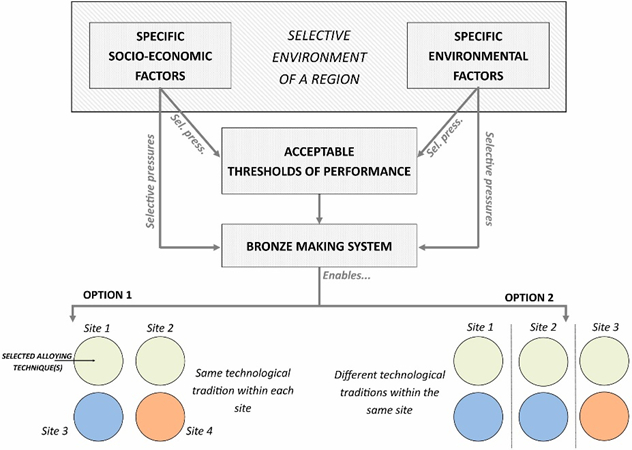
Fig. 1. Diagram illustrating the factors affecting alloying techniques selection. Colours indicate different technological traditions involving a specific combination of alloying techniques.