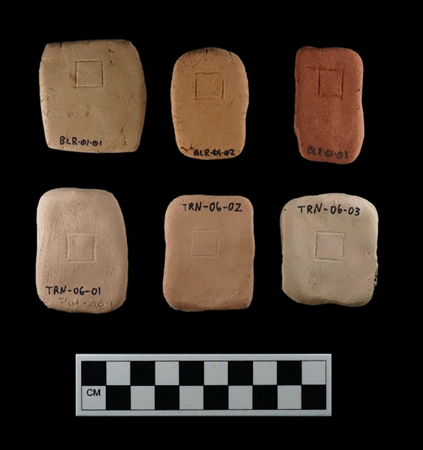
Our latest Paper Spotlight is a new Archaeometry paper from member Kyle Freund (Idaho National Laboratory), "Assessing the Impact of Firing on the Elemental Composition of Clays Using X-Ray Fluorescence Spectrometry."
Highlights:
- Raw clays from eastern Idaho were analyzed with energy-dispersive X-ray fluorescence spectrometry (ED-XRF) both before and after firing to test whether there were significant differences in the elemental composition of these materials.
- The firing of raw clays resulted in a significant loss of mass regardless of firing temperature as well as a statistically significant increase in the measured abundance of each of the 13 elements considered in this study
- Using XRF, provenance assignments of ceramic artifacts to clay sources or alluvial systems can change based on the firing temperature of the comparative clay reference material.
The use of energy-dispersive X-ray fluorescence (ED-XRF) spectrometry for analyzing ceramic artifacts typically centers on identifying geochemical groups within an assemblage and/or matching artifacts to specific clay sources or alluvial systems. For those focused on provenance, there are unresolved methodological issues concerning the effects of firing on the composition of raw clays. For this study, raw clays from eastern Idaho were analyzed with XRF both before and after firing to test whether there were significant differences in the elemental composition of these materials. The results have implications for future provenance studies that compare ceramic artifacts to raw or fired clays.
Freund, K.P., Pink, J.M., Clements, J.G., Cathers, C.M., Woodbury, H.K., Alexander, C., 2026. Assessing the Impact of Firing on the Elemental Composition of Clays Using X‐Ray Fluorescence Spectrometry. Archaeometry. https://doi.org/10.1111/arcm.70171