October’s Executive Board Reading Recommendation comes from VP for Website Administration AJ White. AJ has picked an article on an exciting new magnetic dating technique, and he writes:
I recommend the paper, “Viscous remanent magnetization authentication method for archaeological artifacts,” by Yoav Vaknin and colleagues, for introducing a novel way to discern ancient from modern ceramics. The technique works by determining the strength of a ceramic object’s Viscous Remanent Magnetization (VRM) – more ancient artifacts require a higher VRM removal temperature (VRT) than more recent artifacts, thus providing an estimate of the age of the material. From their study, the authors find that VRT values over 112 °C suggest an age of at least one thousand years. They apply this technique to distinguishing legitimate and fake artifacts in museum collections, which is a useful application in its own right, but I wonder if in time we may be able to determine more precise ages from VRT values to directly date ceramic assemblages. Regardless, it’s not every day that you learn of a new dating method and I commend the authors for their contribution to archaeological and heritage sciences!
Vaknin, Y., Cych, B., Gee, J.S., Tauxe, L., 2026. Viscous remanent magnetization authentication method for archaeological artifacts. Proceedings of the National Academy of Sciences 123, e2620397123. https://doi.org/10.1073/pnas.2620397123
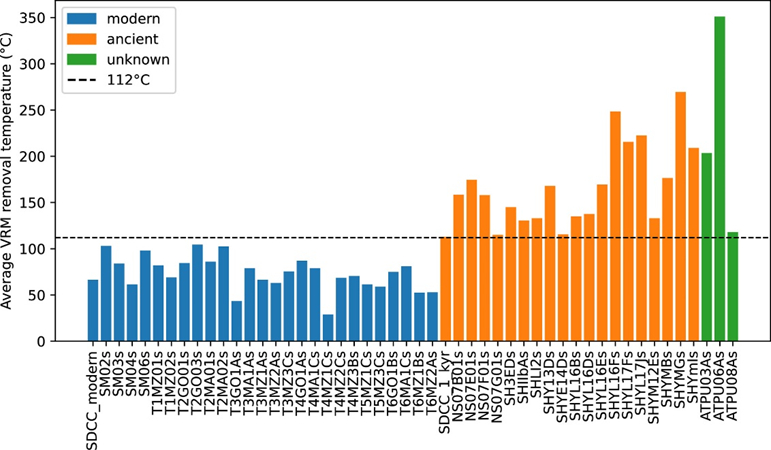
Fig 4. VRM Removal Temperature (VRT) results of all 48 actual specimens and two simulated specimens. The results are based on the VRTC python code (the average of the VRTD and the VRTM). The dashed black line marks the C threshold, which is the VRTD of the 1,000-year-old simulated specimen.