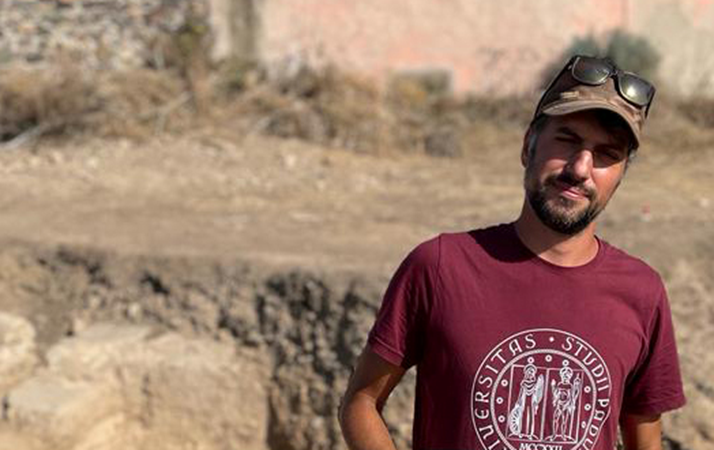
Congratulations to Simone Dilaria, this year’s winner of the SGS Beta-SAS Radiocarbon Dating Award! This annual award is designed to facilitate creative uses of radiocarbon dating, including into geographically and thematically underrepresented areas of research.
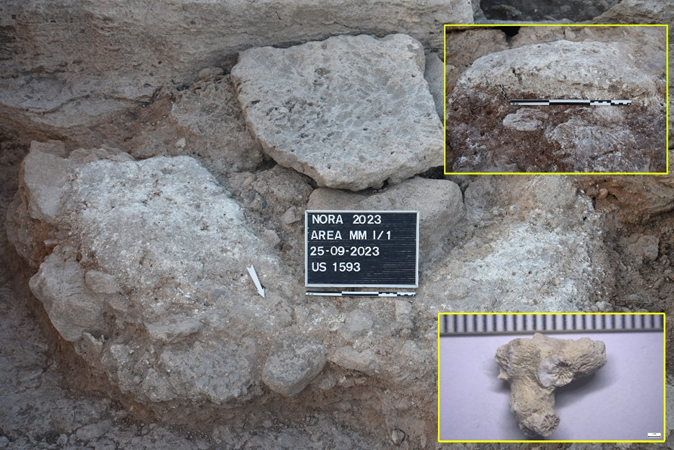
Simone’s project is titled “Burning the Sea: Radiocarbon Dating the First Coral Calcination in the Ancient Mediterranean.” In the Phoenician-Punic necropolis of Nora (Sardinia), a unique lime pit produced by calcining murex shells and coral was discovered among Phoenician cremation tombs dating back to the late 9th century BCE. Supported by the SAS Beta-SGS Award, absolute 14C dating of an uncalcined coral residue embedded within the lime will establish a definitive chronology for this pyrotechnological milestone of antiquity. Originating from a marine context, this Early Phoenician feature is calibrated against the more linear Marine20 curve, potentially circumventing the well-known IntCal20 calibration issues of the Hallstatt plateau. Simone explains that this analysis will not only date what appears to be the first instance of coral calcination in the ancient world, but also demonstrate the early introduction of lime technology to the Central-Western Mediterranean, likely facilitated by the Phoenician diaspora.
Simone Dilaria is currently a Researcher in Mineral Resources and Mineralogical-Petrographic Applications for the Environment and Cultural Heritage at the Department of Cultural Heritage, University of Padua. Since September 2025, he also serves as Adjunct Professor at the same institution and at Ca' Foscari University of Venice (School of International Education).
We look forward to following the results of Simone’s research!