
April’s Executive Board Reading Recommendation comes from General Secretary Kate Klesner. Kate has chosen an exciting new paper on organic residue analysis in South America, published open access this month in Archaeological and Anthropological Sciences by Agustina Vázquez Fiorani, Mark Schurr, Valeria Franco Salvi, and Eleanora A. Reber.
In this paper, the authors use lipid residue analysis, a technique that detects ancient organic compounds preserved inside ceramic vessel walls, to reconstruct what people were cooking and eating in three Formative Period villages (200 and 800 CE) in the Tafí Valley of northwestern Argentina. Working with 172 ceramic vessels from villages which each had an ecologically distinct micro-environment, they combine gas chromatography–mass spectrometry (GC-MS), compound-specific isotope analysis (GC-C-IRMS), and bulk isotope analysis of charred food crusts to identify the signatures of food preserved in the ceramics. While organic materials rarely survive in this part of the Andes due to soil acidity and humidity, this research was able to identify preserved lipids in a large enough group of the samples (36%) to be able to demonstrate that neighboring communities, despite sharing socio-material practices, were pursuing meaningfully different subsistence strategies based on their local environments. The villages in the northern valley show stronger signatures of fat processing from camelids and C3/C4 plants, while the southern village exhibits clearer evidence of C3 plant exploitation. This is the first large-scale direct chemical evidence of subsistence micro-diversity within the Southern Andes, and it opens exciting new avenues for understanding how early communities adapted flexibly to their immediate landscapes rather than following a single, uniform model.
Vázquez Fiorani, A., Schurr, M., Franco Salvi, V., Reber, E.A., 2026. Revealing micro-environmental subsistence diversity in the Southern Andes through organic residue analysis in pottery (Tucumán, Argentina, 200–800 CE). Archaeological and Anthropological Sciences 18, 96. https://doi.org/10.1007/s12520-026-02462-0.
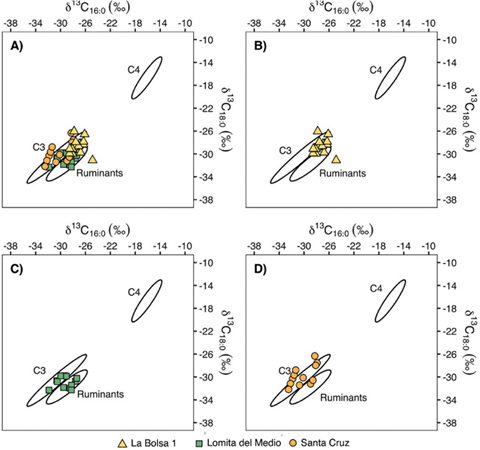
Inter-site patterning of carbon stable isotopes (Vázquez Fiorani et al. 2026, Fig. 6)