
This is our second spotlight on a paper based on research supported by the SAS Student and ECR Research Support Award. 2023 winner Sutonuka Bhattacharya is a PhD student at the Institute of Archaeology at Hebrew University of Jerusalem and a Research Assistant at the Sharma Centre for Heritage Education in Chennai. She recently published “Grinding stones from the neolithic “Ashmound” site of Budihal, India” in Archaeological Research in Asia.
Highlights:
- Techno-functional analysis: The study presents the first detailed analysis of sandstone grinding stones from the Neolithic Ashmound site of Budihal (∼2480–1580 BCE), integrating typology, 3D modelling, and surface analysis.
- Raw material and manufacture: Grinding stones were made exclusively from locally available sandstone slabs, with minimal initial shaping and consistent technological strategies involving flaking, rim formation, and pecking.
- Use-life and variability: Variations in surface concavity, rim thickness, and pecking intensity suggest functional differentiation, task-specific practices, and evidence of tool rejuvenation and reuse."
Grinding stones are among the most ubiquitous artefacts at Southern Neolithic sites in peninsular India, yet their technological, functional, and socio-cultural significance remains insufficiently explored. This paper presents a techno-functional analysis of sandstone grinding stones from the Neolithic site of Budihal (c. 2480–1580 BCE), located in the Shorapur Doab, Karnataka. It employs an integrated methodology combining typological classification, 3D modelling, and surface analysis to investigate raw material selection, manufacturing techniques, working surface modification, and use-life histories. The results highlight consistent technological strategies, including the selection of locally available sandstone slabs, minimal initial shaping, and the use of flaking and pecking for surface preparation. Variations in surface morphology and wear patterns suggest functional differentiation and possibly user-specific practices. Contextual evidence points to their use and storage within domestic contexts, with reuse and discard patterns reflecting broader Neolithic technological traditions.
We hope you enjoy reading about Sutonuka’s research, and congratulations to her and her colleagues! Find out more about how to share your work with a Spotlight.
Bhattacharya, S., Paddayya, K., Akhilesh, K., Goren-Inbar, N., Shelach-Lavi, G., Pappu, S., 2026. Grinding stones from the neolithic “Ashmound” site of Budihal, India. Archaeological Research in Asia 46, 100704. https://doi.org/10.1016/j.ara.2026.100704
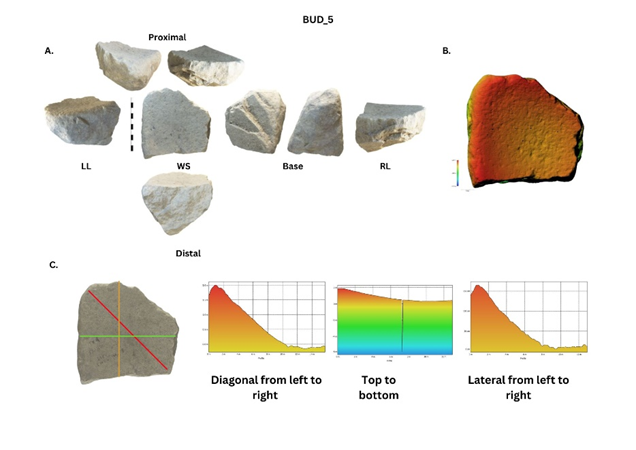
Documentation of a grinding stone (Bhattacharya et al. 2026, Fig. 4)