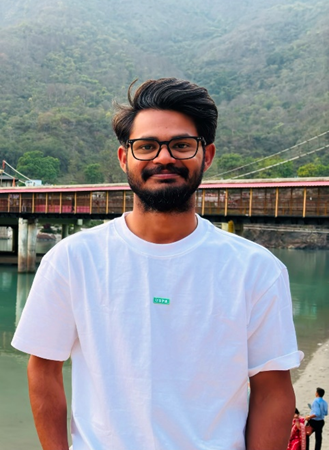
Congratulations to Amit Ranjan (Ashoka University), the 2026 winner of the Eurofins EAG Laboratories-SAS Student Pilot Research Award! This award is designed to support the collection of preliminary chemical data for use in major funding applications.
Amit’s project is titled “Tracing the change and continuity in Provenance and Production Technology from Pre-Urban Phase to Urban Harappan phase at the site of Rakhigarhi.” This research aims to investigate continuity and change in ceramics production technology and provenance from the Pre-Urban Harappan to the Urban Harappan phases at Rakhigarhi, with particular attention to mound RGR-7. It examines whether ceramic production developed gradually from earlier regional traditions such as Hakra and Sothi-Siswal or underwent significant technological and material transformations because of intra-site and inter-regional interaction. The study integrates traditional typological analysis with archaeometric methods, such as ICP-MS and SEM-EDX, to locate local clay sources, characterize ceramic raw materials, and reconstruct production technology.
Amit Ranjan is a PhD student at Ashoka University, working with Dr. Kalyan Sekhar Chakraborty. He investigates ancient ceramic production technologies and provenance, aiming to reconstruct the development, transmission, and adoption of technological knowledge across generations and cultures. His work explores standardization in ceramic production, the selection and provenance of raw materials, tempering practices, firing conditions, and slipping techniques. Using advanced analytical methods—including ICP-MS, FTIR, XRD, SEM-EDX, and petrography—he analyzes the chemical and mineralogical composition of ceramics to understand the local and non-local production, technology, craft specialization, trade, and exchange, socio-economic and cultural significance. This interdisciplinary approach sheds light on the dynamics of ancient urbanism and inter-regional interactions in South Asia.
SAS is grateful to Eurofins EAG Laboratories for their support of this award. Congratulations again, Amit!