SAS member Andrew Millard has shared a paper recently published in Quaternary Science Reviews (February 2026), co-authored with colleagues Meng Zhang and Dan Lawrence from Durham University, on diet and agriculture in China: “Isotopic evidence for changing diet and agriculture in China from the Neolithic to the Early Han period (10-2 ka BP).”
Highlights
- Compiled a large C–N isotopic dataset (N_human=3,492; N_animal=2,919) to reconstruct prehistoric subsistence in China 10–2 ka BP
- Reveals early, persistent millet farming in the Middle Yellow River with millet-fed pig husbandry dominant from Early Neolithic
- After ∼5 ka BP, farming split: millet–pig systems in Middle Yellow River and wheat and barley pastoral economies in northwest China
Summary
Carbon and nitrogen isotope analyses for ca. 3000 animals and 3500 humans shed light on the changing farming practices from the Neolithic to the Early Han Dynasty across China. Feeding pigs with the C4-crop millet started in the Early Neolithic in the Middle Yellow River region, and later spread, but in marginal zones pig husbandry diets varied widely. The introduction of western domesticates after 5 ka BP led to two distinct farming regimes. Subsistence based on millet and pigs persisted in the Middle Yellow River region, integrating cattle and sheep into existing millet-based fodder regimes. Conversely, the arid northwestern regions shifted to farming centered on sheep/goat and the C3-crops wheat and barley. In all periods we found deer a useful indicator of wild animal access to crops. The regional differences highlight how local ecologies and resource availability shaped regionally distinct trajectories of farming in prehistoric China.
DOI: https://doi.org/10.1016/j.quascirev.2025.109725
Congratulations to Meng, Dan, and Andrew! We hope you enjoy reading their work. Find out more about how to share your work with a Spotlight.
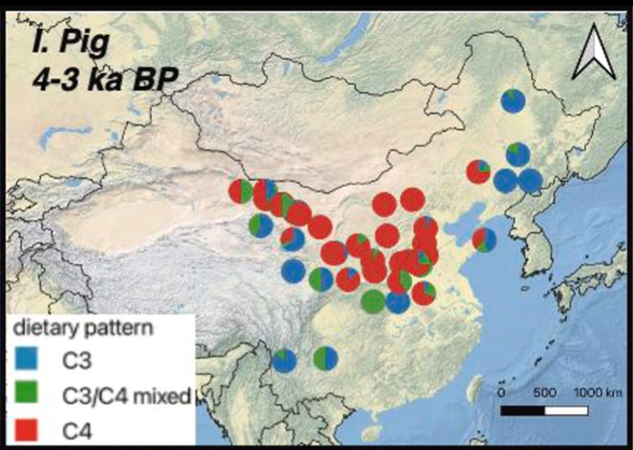
Spatiotemporal distribution of C3 and C4 consumption of human and pig across China. Zhang et al. 2026, Fig. 9 (licensed under CC BY 4.0)