Our next paper spotlight on SAS-supported research comes from 2015 Student and ECR Research Support Award winner Kuan-Wen Wang (Institute of History and Philology, Academia Sinica). Kuan-Wen’s research on Iron Age glass from Taiwan was published in PLOS ONE in 2022: “The production technology of mineral soda alumina glass: A perspective from microstructural analysis of glass beads in Iron Age Taiwan”
Highlights
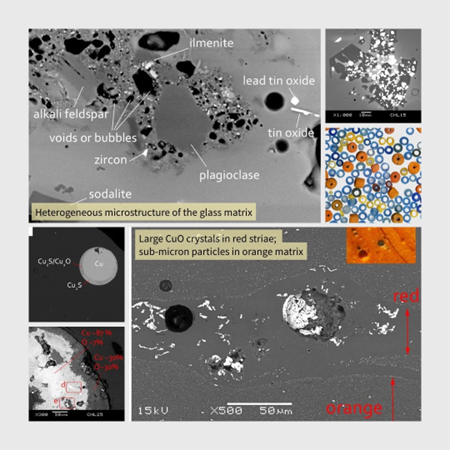
- One element, many colours: copper-based colourants dominate the red, orange, blue, and green glass in Iron Age Taiwan, with green achieved by combining cupric copper and lead stannate. The copper-based ingredients could produce strikingly different colours depending on how craftspeople controlled redox conditions and selected among various copper-containing raw materials, revealing a sophisticated pyrotechnological knowledge system.
- Glass and copper were not separate worlds: microstructural evidence shows that bronze scraps, oxidised copper scales, and metallurgical by-products may have been deliberately repurposed as glass colourants. This points to active knowledge exchange and resource sharing between glass and copper-working communities across the Indo-Pacific.
- Hidden in the yellow: two distinct microstructural patterns in yellow glass - one where lead-tin oxide clusters with newly crystallised nepheline and another where it distributes more evenly, point to fundamentally different ways of preparing and introducing the colourant. This subtle difference hints that the story behind these beads may be more complex than it appears: different production pathways, perhaps different workshops, perhaps different traditions entirely.
Mineral soda alumina (m-Na-Al) glass was one of the most widely traded materials in the first millennium CE Indo-Pacific world, yet how it was actually made remains less understood. This study, building on the author's doctoral research at the University of Sheffield and further developed at Academia Sinica, uses SEM-EDS and EPMA microstructural analysis of 63 m-Na-Al glass beads from Iron Age Taiwan to shift the conversation from provenance to production. Craftspeople worked at temperatures around or below 1000°C using poorly refined sand, and copper in various forms could produce red, orange, blue and green glass through skilled control of firing conditions. A self-reduction process is tentatively proposed for red and orange colours. Two distinct microstructural pathways in the yellow glass hint at different colourant preparation strategies and possibly different workshop traditions, pointing to sophisticated craft knowledge and sustained cross-craft interaction between glass and copper-working communities across the Indo-Pacific.
Wang, K.-W., Iizuka, Y., Jackson, C., 2022. The production technology of mineral soda alumina glass: A perspective from microstructural analysis of glass beads in Iron Age Taiwan. PLOS ONE 17, e0263986. https://doi.org/10.1371/journal.pone.0263986