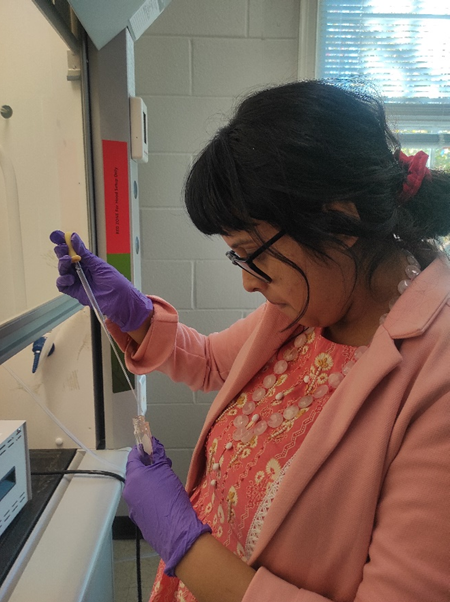
SAS has been highlighting research facilitated by our Student and ECR Research Support Award. We are excited to share a paper by 2021 award winner Ahana Ghosh (Indian Institute of Technology Gandhinagar). Ahana’s paper “Does form entail function? Understanding pottery functionalities through absorbed residues within ceramics from the Harappan sites of Karanpura and Ropar in India” was recently published in Quaternary Environments and Humans.
Highlights
- Uses organic residue analysis (ORA) to directly determine pottery function, moving beyond traditional form-based interpretations.
- This study demonstrates that Harappan pottery was multifunctional, used for processing plant, animal, and possibly aquatic resources. It reinterprets perforated vessels, showing they were not exclusively for dairy but also used for non-dairy/oily substances.
- Highlights the importance of ceramic porosity and environmental factors in lipid absorption and preservation.
- Provides new insights into Harappan foodways and subsistence practices through integration of lipid, faunal, and botanical data
This paper investigates the function of Harappan pottery from Karanpura (Rajasthan) and Ropar (Punjab) using organic residue analysis (ORA) of absorbed lipids. Moving beyond traditional typological approaches, the study directly examines chemical traces within ceramics to identify vessel use. Analysis of 15 potsherds reveals evidence of plant, animal, and possibly aquatic resource processing, indicating that Harappan pottery was multifunctional rather than form-specific. Perforated vessels, often associated with dairy production, show signatures of non-dairy and oily substances, challenging earlier assumptions. The study also highlights the role of ceramic porosity and environmental conditions, such as soil pH, in lipid preservation. By integrating residue data with faunal and botanical evidence, the research reconstructs aspects of Harappan subsistence and culinary practices. Overall, it demonstrates the value of scientific techniques in reinterpreting ancient material culture and provides new insights into foodways and technological practices in the Harappan Culture.
Ghosh, A., Prabhakar, V.N., Reber, E.. A., Liston, H., Kirubakaran, S., K.s., S., Talekar, U., Bhardwaj, M., Vishwakarma, A., Channarayapatna, S., 2025. Does form entail function? Understanding pottery functionalities through absorbed residues within ceramics from the Harappan sites of Karanpura and Ropar in India. Quaternary Environments and Humans 3, 100050. https://doi.org/10.1016/j.qeh.2024.100050
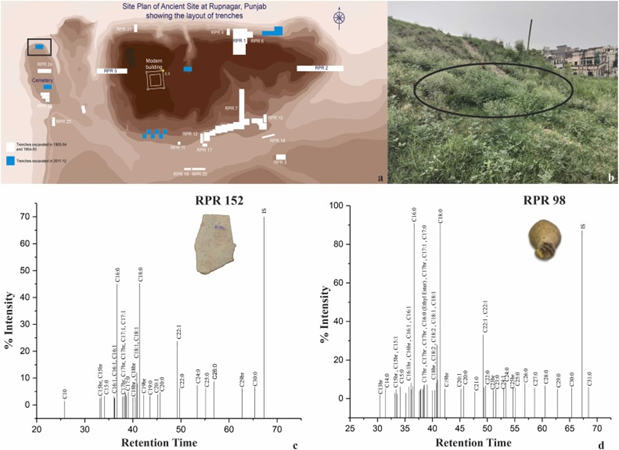
Fig. 5. Ropar: (a) Map of the site representing the layout of the trenches and the sample collection areas for the present study; (b) Present-day photograph of the site showing the exact location of the excavated trench from where the samples were collected (C) Histogram representation of RPR152 (d) Histogram representation of RPR98.