Conferences & Networking
The SAS regularly sponsors conferences, workshops, and conference sessions. If you are planning an event relevant to the goals of the society, please get in touch with the VP of Intersociety Relations so that we can explore a partnership. If you're a student SAS member interested in promoting professional fellowship among your peers, check out the Student Ambassador program and reach out to our VP for Membership Development to learn more.
- Ben Marwick
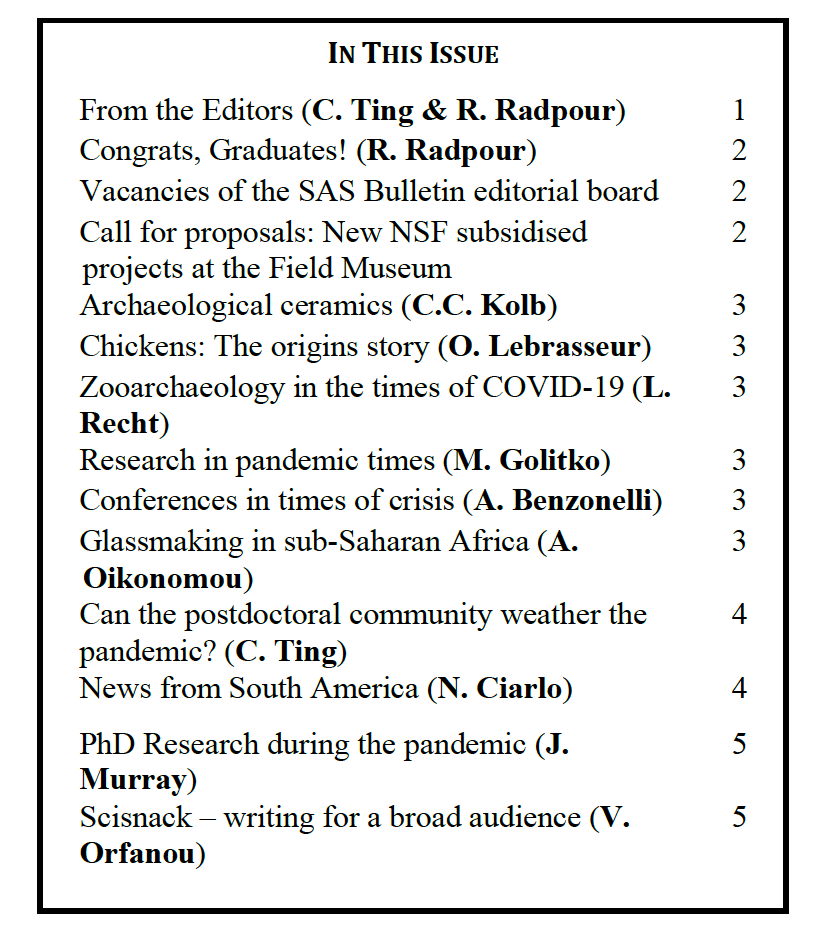
Our diligent and excellent editor, Carmen Ting, has just released a new issue of the SAS Bulletin! This is Volume 43, Number 3, Autumn 2020, and has lots of great content. Below is a screenshot of the table of contents, and you can see the full text of all the articles at http://socarchsci.blogspot.com/ To download a PDF of this issue, click here. Congratulations Carmen, and thank you for putting together this wonderful issue!
We are proud to announce that the Journal of Archaeological Science and Society for Archaeological Sciences Emerging Investigator Award for 2019 has been awarded to Hector Orengo and Arnau Garcia-Molsosa, for their paper 'A brave new world for archaeological survey: Automated machine learning-based potsherd detection using high resolution drone imagery' (https://doi.org/10.1016/j.jas.2019.105013). The panel commended the visionary combination of drone-based photogrammetry, machine learning and parallel computing in an open source environment, with the potential to revolutionise traditional field survey methods.
The authors will receive a $500 cash prize, and the manuscript will be freely available for 12 months. In addition, the manuscript will be highlighted in JAS and SAS communications and websites.
JAS and SAS have partnered in this new initiative to highlight and celebrate the key role of early career researchers in advancing archaeological science. We acknowledge all of the excellent submissions for this award, which demonstrate the exciting new scientific directions that early career researchers are working in.
This is the inaugural year for the award and we encourage submissions for the next round. All nominated papers with a publication date in 2020 will be considered, and the award announcement will take place early in 2021. The purpose of this award is to promote and acknowledge research excellence among early career scientists and provide an international venue for publication of significant work. The research must have a notable impact in the field of archaeological science.
Charles Kolb, our Associate Editor of Archaeological Ceramics, has handpicked and reviewed some books to help you navigate through the quarantine and self-isolation season.
Read more: The Lockdown Book Club: Book Reviews by Charles Kolb
By Agnese Benzonelli, Associate Editor of Archaeometallurgy
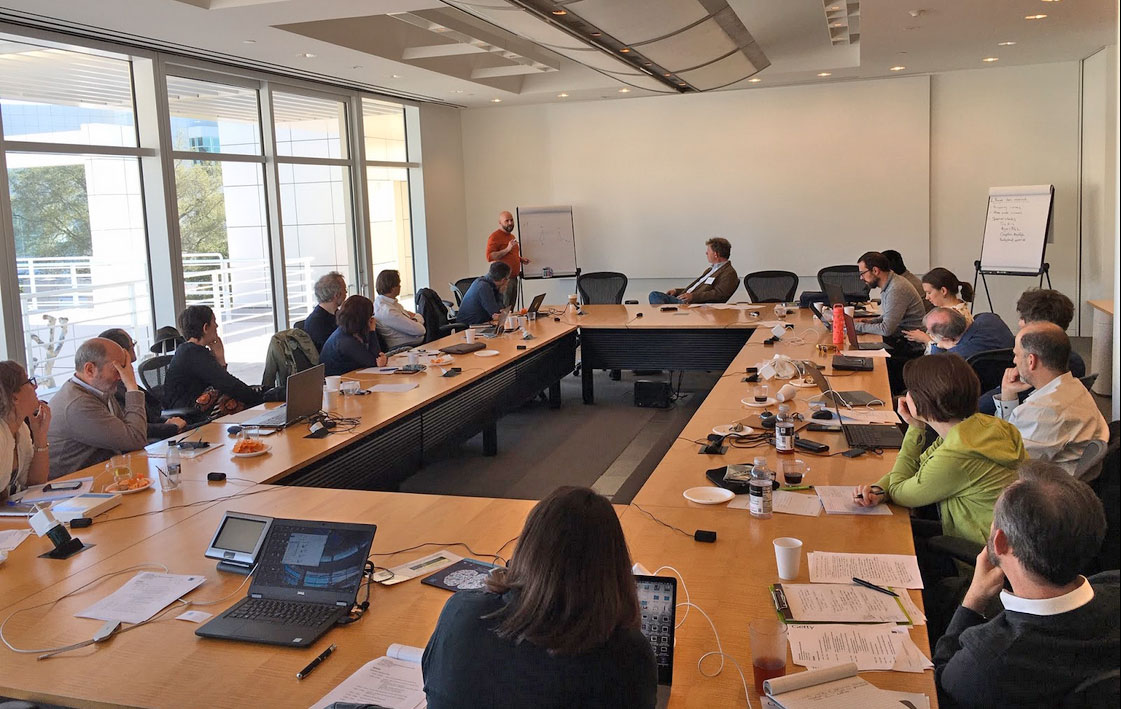
The ‘Round Table on XRF: The Future of Collaborative Research on Copper Alloys’ held at the Getty Museum in February gathered 18 international experts in the field of portable x-ray fluorescence from various major universities (University of Buffalo, University College London, University of Cambridge, University of Oxford, University of Turin) and institutions, including the J. Paul Getty Museum, MET, MoMA, National Gallery of Art, Opificio delle Pietre Dure and the Rijksmuseum. The meeting discussed three main topics: the evolution of the technique in the last decade, the identification of specific research topics that need to be explored further and the development of shared databases and how to manage them.
Read more: Workshop Review: XRF Roundtable at the J. Paul Getty Museum
By Mark Golitko, Associate editor in lithic and network analysis
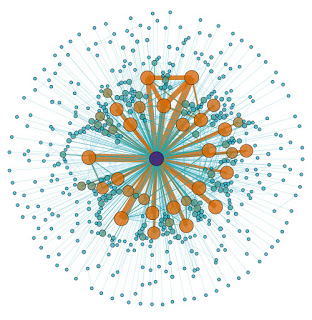
This is my first blog since being asked to serve as associate editor for lithic analysis and network analysis. It is somewhat delayed due to the global pandemic and the strange adjustments we have all had to make (teaching and conducting all business online in my case). The spread of Covid-19 itself, and the rapid dissemination of fake news and strange conspiracy theories surrounding the virus have served to highlight the complexity of the global human network to which we all belong, such that a virus that jumped to the human population somewhere in Wuhan, China, reached South Bend, Indiana (where I currently sit writing this) after only about two or three months.
By Laerke Recht, associate editor in Zooarchaeology
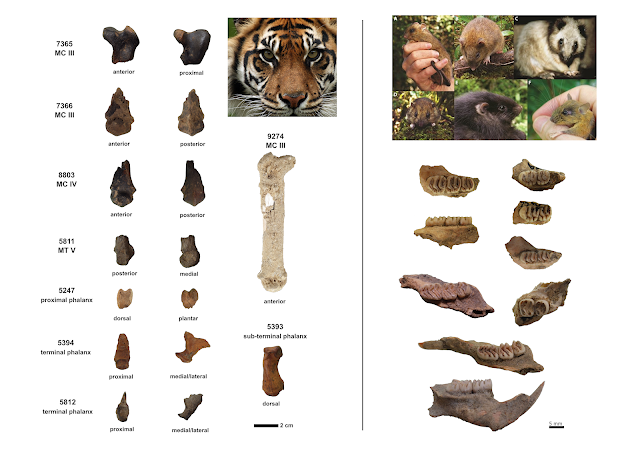
As my first contribution to this newsletter, I want to highlight two new zooarchaeology-related things that I am excited about:
- New associate editor of archaeological organic materials
- Interview with the winners of the SAS-JAS Emerging Investigator Award 2019
- Interview with Dr Chris Vyhnal by Roxanne Radpour about the role of archaeological science in teaching chemistry and experimental science in high school
- Technological examination of copper bolts