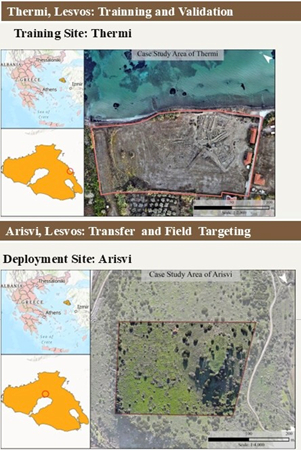
We are happy to share a new paper by SAS member Georgios Alexandros Asvestas (Department of Geography, University of the Aegean) on predictive modelling for archaeological fieldwork, recently published in Journal of Archaeological Science: Reports, “Multi-sensor UAV predictive modelling for archaeological feature detection: from probability surfaces to excavation targets on Lesvos Island, Greece.”
Highlights
- UAV thermal, multispectral, LiDAR fusion via interpretable logistic regression.
- Cross-sensor independence of thermal and topographic domains quantified via Spearman correlation.
- Thermal and topographic components transferred without refitting; vegetation failure traced to seasonal domain shift.
Summary
Archaeological predictive modeling often struggles with single-sensor limitations, opaque statistical methods, and difficulties in transferring models across different landscapes. Furthermore, translating broad probability maps into actionable field excavation targets remains a persistent challenge. To address these issues, this paper introduces an integrated, drone-based workflow that combines thermal, multispectral, and elevation data using transparent statistical modeling. The methodology was developed and trained at a documented archaeological site, and then successfully transferred to an unexplored site without requiring model retraining. By incorporating spatial hotspot clustering techniques, the framework effectively narrows down large survey areas into prioritized, high-confidence zones. Ultimately, this approach bridges the gap between remote sensing data and practical field archaeology, offering a robust, cost-effective tool that enhances prediction accuracy, spatial transferability, and targeted resource allocation for archaeological prospection.
Congratulations to Georgios Alexandros Asvestas and his co-author, Christos Vasilakos! Find out more about how to share your work with a Spotlight.
Asvestas, G.A., Vasilakos, C., 2026. Multi-sensor UAV predictive modelling for archaeological feature detection: from probability surfaces to excavation targets on Lesvos Island, Greece. Journal of Archaeological Science: Reports 76, 106114. https://doi.org/10.1016/j.jasrep.2026.106114