July’s Reading Recommendation comes from SAS President-Elect Paul Szpak, who shares a pair of exciting articles on advances in nitrogen isotope research. Paul writes:
We have known for 40 years that nitrogen isotopes can provide us with information about the trophic position of an animal – where it sits in the ‘food chain’. This has been very useful for studying past human populations, allowing us to make inferences about the relative importance of, for example, animal and plant foods. One limitation, however, is that we require well-preserved protein in our ancient samples (most commonly collagen in bones), which almost never survives beyond 100,000 years. A series of recent studies have used an ingenious and novel approach to get around this problem. They’ve targeted tooth enamel, which contains very little organic material and therefore also very little protein, and adapted a method that uses bacteria to convert nitrate into nitrous oxide, which can then be used to determine the ratio of nitrogen isotopes in the same. This method was originally designed to measure nitrogen isotopes in seawater nitrate and can work with extremely small quantities of nitrogen, which is an absolute game changer for those interested in studying the deep past. One early application analyzed nitrogen isotopes in the tooth enamel analyzed the enameloid (similar to enamel) in megatooth sharks (Kast et al., 2022), finding that the famous megalodon (Otodus megalodon) was a top predator, feeding on baleen whales. The ancestor of ‘the meg’, the slightly smaller Otodus chubutensis, fed even higher up in the food chain, consuming predatory sperm whale-like creatures that prowled the seas millions of years ago. More recently, this technique was applied to South African australopithecines (Lüdecke et al., 2025) , revealing a predominantly plant-based diet, suggesting limited consumption of animal proteins. This study provided unprecedented insight into the diets of our hominid ancestors and future studies are sure to shed further light on this issue of meat consumption in our hominid ancestors from a quantitative perspective. When did it really become important and how might that connect to other major developments in human history?
Kast, E. R., Griffiths, M. L., Kim, S. L., Rao, Z. C., Shimada, K., Becker, M. A., …
Sigman, D. M. (2022). Cenozoic megatooth sharks occupied extremely high trophic positions. Science Advances, 8(25), eabl6529.
Lüdecke, T., Leichliter, J. N., Stratford, D., Sigman, D. M., Vonhof, H., Haug, G. H., …
Martínez-García, A. (2025). Australopithecus at Sterkfontein did not consume substantial mammalian meat. Science, 387(6731), 309–314.
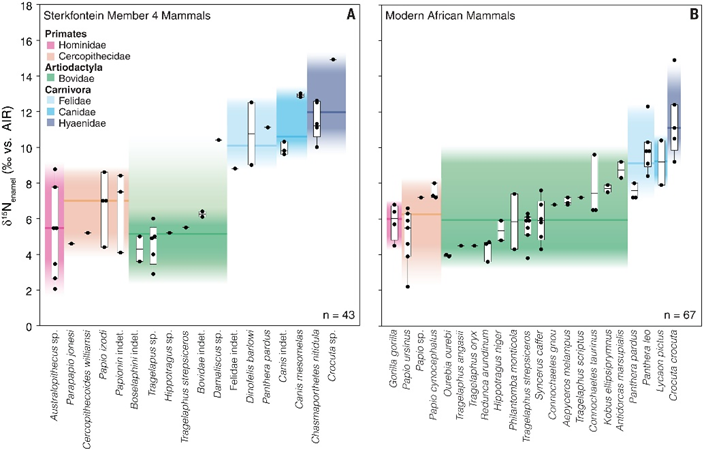
Lüdecke et al. 2025, Fig. 1: Sterkfontein Member 4 and modern enamel nitrogen isotope data