The SGS Beta-SAS Radiocarbon Dating Award supports the creative use of radiocarbon dating. The 2026 winner, Simone Dilaria (Department of Cultural Heritage, University of Padua), used the award for his project "Burning the Sea: 14C dating for Early Coral and Shell Calcination in Sardinia.”
Simone reports on the results of the analysis below:
This project investigates an exceptional stratigraphic context discovered in the suburban periphery of the ancient city of Nora, Sardinia. Excavations revealed a pit for lime slaking cut directly into a natural alluvial clay deposit overlying the bedrock. Crucially, this lime pit is stratigraphically cut by a Phoenician cist tomb dated to the mid-seventh century BCE based on its burial assemblage, establishing a definitive terminus ante quem for the lime-production activities. Archaeometric examination revealed that the lime was produced through the calcination of mollusk shells alongside an unusually high concentration of coral fragments. While shell calcination is attested in later Classical periods, the intentional calcination of coral is entirely unprecedented in the Mediterranean archaeological record. To establish an absolute chronological framework for this milestone in ancient pyrotechnology, the SGS Beta-SAS Radiocarbon Dating Award supported the AMS radiocarbon dating of an uncalcined coral residue, designated sample CORAL_3, embedded within the lime paste.
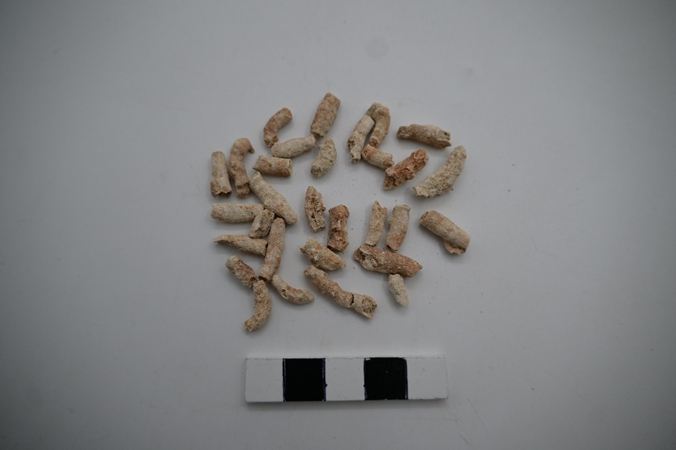
Assemblage of unburnt coral residues
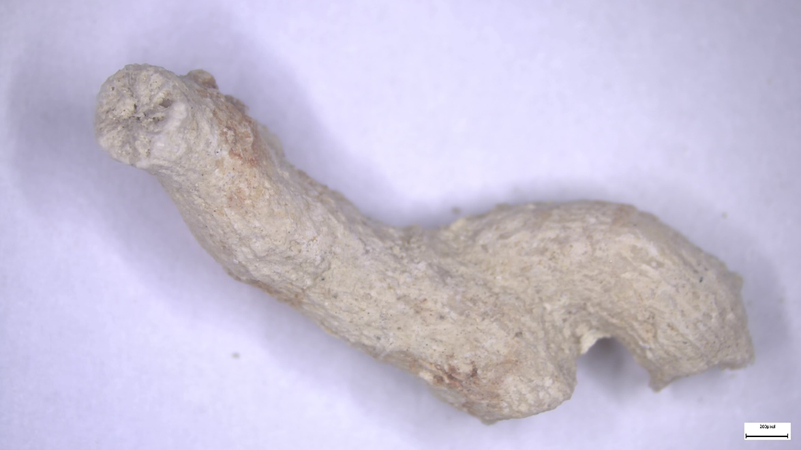
Analyzed sample of coral
The radiocarbon analysis conducted by Beta Analytic on a coral sample (CORAL_3 / Beta-818657) yielded a very surprising result: a conventional radiocarbon age of 41,690 ± 650 BP, which calibrates to approximately 44,000 cal BP (Upper Paleolithic). While this date does not directly reflect the protohistoric operational phase of the lime-slaking pit, which is stratigraphically sealed by a mid-7th century BCE Phoenician tomb, the result is analytical robust and opens up a remarkably intriguing scientific scenario. Rather than harvesting living coral from active reefs, the ancient lime-burners were apparently collecting dead, subfossil coral fragments from beach deposits or the seabed (perhaps retrieved during fishing activities) to use as raw material for lime production. This unexpected outcome provides novel insights into ancient raw-material selection and pyrotechnological practices.
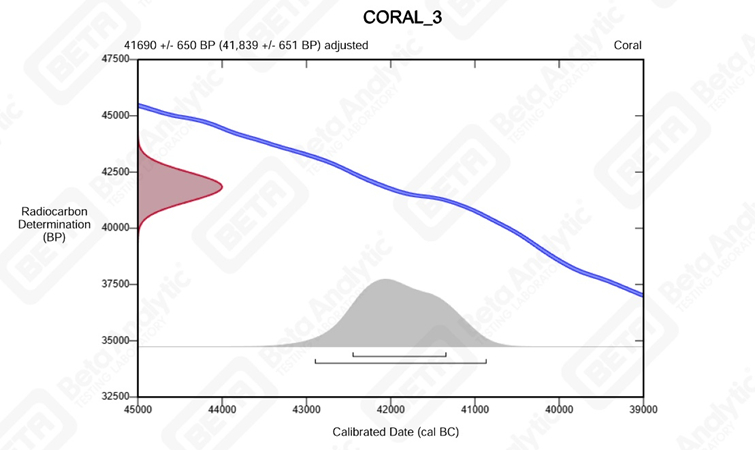
Result of the C14 dating
To further clarify the deposit's chronological framework and confirm this sourcing strategy, Simone and his colleagues plan to proceed with radiocarbon dating on the remaining samples from the context, including the Murex shell and additional coral fragments.
The results of the project and of the 14C dating will be presented in the poster "Turning the Sea to Lime: Coral and Mollusk Shell Calcination in Phoenician Nora (Sardinia)" at the XI International Congress of Phoenician Studies (Valletta in Malta, 9-13 November 2026).
Congratulations again to Simone, and our warmest thanks to SGS Beta for supporting this innovative and interesting research!